Archive

Posts Tagged ‘Apple’

Lemme Get Back To You

September 22nd, 2017 No comments

Source: Apple suffers embarrassing demo Face ID fail at iPhone X launch 

Without question, over the past decade, the smart phone has been the most influential product in the world eclipsing the personal computer, disposable diapers and likely the wheel for the number one spot.  An article was written years ago making light of the influence of phones, but in modern communities everywhere, smart phones and Iphones in particular, have achieved a must have status in society on the plane of Starbucks and bottled water.  Phones have attained the status of social jewelry.  Girls don’t compare rings, they compare phone versions.

From starting off as a mere convenience, smart phones have become an absolute necessity for most people.  We’ve all heard anecdotal stories of people suffering genuine panic at the thought of losing their phones and not only because they’re worth the cost of a few car payments.  These days, who doesn’t have their entire life story embedded in their phones, from pictures and videos to chat sites links, contact lists and passwords to various consumer sites?

People have undeniably become addicted to phone usage and this addiction has given rise to the popularity of social media companies that otherwise have no value.  Facebook, Twitter, Snapchat, Instagram etc etc, all social equivalents of crack cocaine for the insatiable appetites of the Look At Me crowd.  You would think that having access to what everyone else is doing or thinking would be a boon to society.  I can argue that it is not.  Rather than expanding thought and knowledge, instead people have become more tribal as they divide themselves into camps of thought that align with their particular worldview and this is reinforced by others similarly opined, resulting in an echo chamber vortex.

As we’ve touched on before, anyone can create a sympathetic following for an issue, no matter how inane, just by virtue of being fleetingly famous.  Regardless of how inarticulate or erroneous a position may be, it can still draw in like-minded supporters as if they were Charles Manson devotees.  For a more comprehensive view of this phenomenon, read the classic work by Charles Mackay, “Extraordinary Popular Delusions and The Madness Of Crowds.  Make no mistake, this is all crowd behavior.

Apple Phones have been the conduit of choice (mostly) for this tribal narcissism and on almost a yearly basis, the faithful line up for hours in fervid anticipation of the release of the newest iteration of the holy tool.  Recently, for the first time ever, the newest release, labeled X, has failed to generate the must have hysteria that accompanied every other iteration.

Maybe the product fails to offer new gee whiz features.  Maybe people don’t need to have a new device with only marginally newer features.  Maybe people don’t feel the need to spend four digits on an appliance.  Or maybe people have just decided…it’s only a phone.


You Spelt It Wrong

August 2nd, 2016 No comments

Source: Apples plan to change pistol emoji will sow confusion, retroactively alter meaning – Business Insider

Without a doubt, the advent of the GUI interface, widely popularized by Apple, changed the way that computers and smartphones are used and has given rise to an entire industry of app developers intent on making services and communications more accessible to all users regardless of levels of literacy.

It’s no coincidence that I-Pads became the pacifier of choice for people babysitting small children. The manipulation of colorful objects on the screen captivates young minds and they can be left alone for hours amusing themselves.  The ease of communicating and navigating by pointing and moving fingers is basic and obviates the need to have any language skills. Playing games on the small screen became a standard skill acquired by all kids.

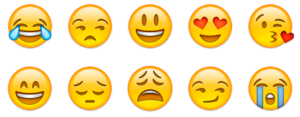
Building upon that enormous base as children move into adulthood, phone and app makers have extended that formative phase into products that retain their customer base.  Nowadays, people can communicate on their devices by swiping, entering emojis and clicking on icons in lieu of actually forming a written thought.  It’s as if the evolution of language skills are regressing backwards.

When people first began to communicate visually, it was undoubtedly with simple pictograms and symbols crudely representing ideas.  Obviously, this left some room for ambiguity since many people don’t draw well.  Even if you drew a hand, did that mean stop? give me more? the number five? or look at my new glove?  Eventually, the Chinese assembled pictograms into a cohesive language but there was still plenty of room for ambiguity since their pictograms represented ideas more than precise definitions.

Eventually, someone invented the alphabet and voila, much more precise communication was possible.  How-to manuals were much easier to follow as were medical procedures.  Somewhere along the way, language began to fray at the edges as variations and distortions of language came into acceptance as pop culture personalities bastardized their accepted constructs.  It may be only a matter of time before spoken language reverts back to a series of clicks, pops and grunts.

The written language is already reverting back to infantile levels with the substitution of amusing and cute emojis for clever, witty dialogue.  The fascination with symbols, emojis,  games and icons may be extending adolescence and the affinity for cuteness for an entire generation. People have never been so hooked on virtual life as they have recently with video apps and games.   Think of the Pokemon go phenomenon sweeping the world now.  It’s only a matter of time before Hello Kitty becomes  a mascot for a college football team.  While convenient for device users, there’s another side to this convenience of communication, a darker side; social engineering.

Phone apps are ironically contributing to the demise of literacy in the modern world.  Nuanced conversations now revolve around the interpretations of the expressions on an emoji sent or received rather than the relative certainty of a written phrase.  Soon it will be acceptable for academic theses to be submitted using only emojis and pictograms leading to actual academic towers of babble. White face and horizontally striped shirts will be all the rage as mimes become the high priests of communication.  We’re moving towards a dark period of human evolution when accepted communication begins to resemble ransom notes from a 3 year old.

I sign off with this message:

facts_8


pardon the spelling.